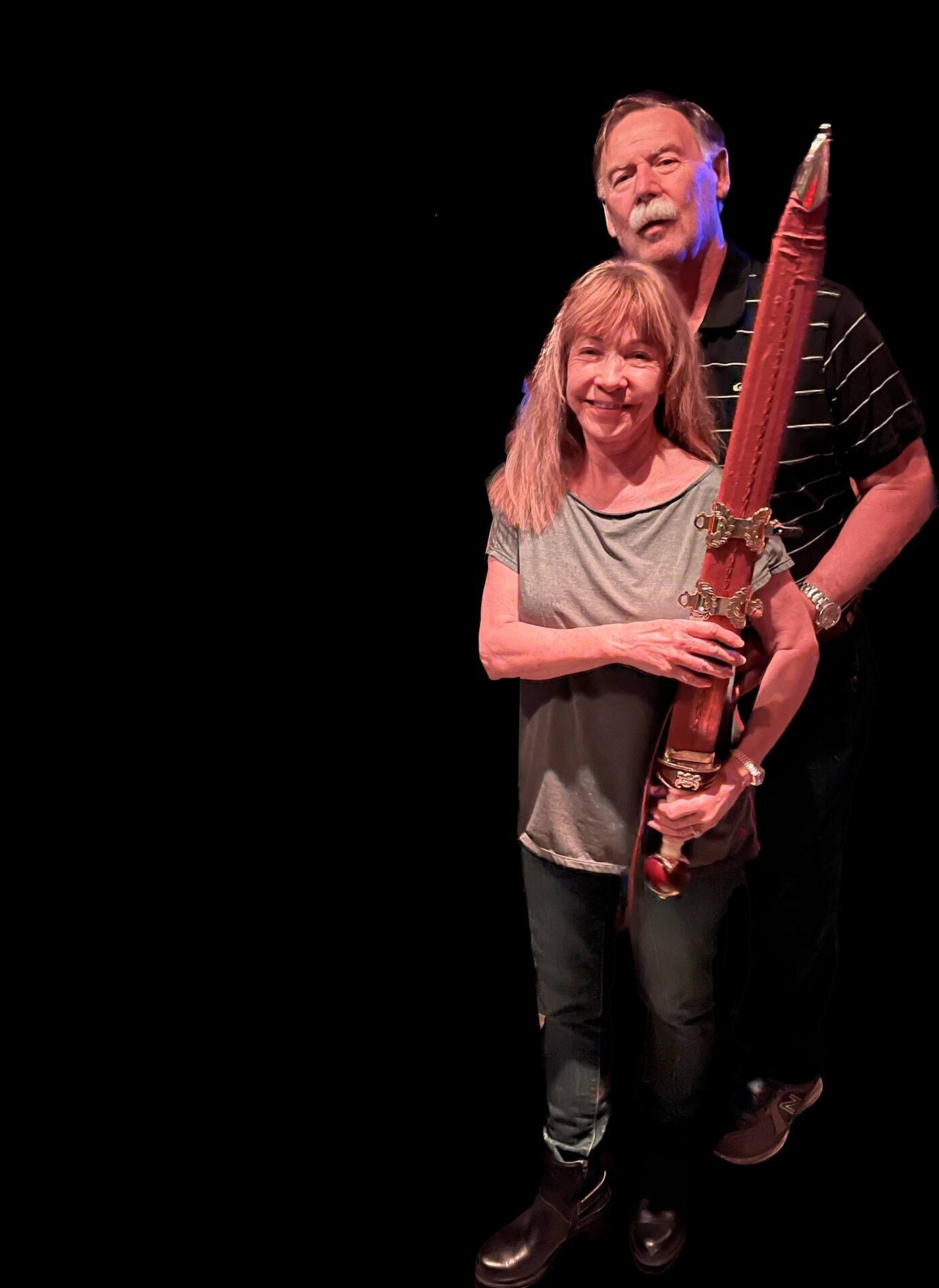
Greetings everyone!
This edition is a long one, but I think you'll forgive me.
In it: I run an experiment that changed my mind about the future of game development, a friend of mine does something wonderful with cardboard, and Roberta and I dodge bears in Alaska.
Let's start with the experiment.
GAME DEVELOPMENT IN THE AGE OF AI
Is AI killing the game business? Is it coming for game dev careers?
I don’t know that I have the final answer, but I do have a fresh perspective.
When Roberta and I developed our most recent game, Colossal Cave 3D, we started the project with just a friend of mine, Marcus Mera, and me. Within a few weeks we actually had the game running.
Me (Ken), Capt Garrett, Chef Dani and a very happy Roberta
Left to right: Roberta, Marcus, and I.
Unfortunately, the truth is that it wasn’t very good.
That’s not a criticism of Marcus. He’s talented. And I have decades of game development experience. I chose Colossal Cave because I thought it was a fairly simple, well-defined task — and also a very good game. I thought it would be a fun project.
But the reality was that we needed more than two people.
So I hired another artist. Then another engineer. Then another. And another.
By the time we were done, the team had grown to thirty-five developers and the game had cost over $1.5 million to produce.
Just some of the people we worked with.
Just some of the people we worked with.
Ouch.
I’m proud of the game, but with 20/20 hindsight, some of that money was wasted. For example, I spent money developing for the Apple Vision Pro headset, which turned out not to be the world’s greatest business decision.
My takeaway from Colossal Cave 3D was that the days when one developer in a garage could ship a hit game were mostly over. Yes, it still happens. Most lotteries have a winner too. But I wouldn’t build a business plan around winning the lottery.
That was before I had really heard of AI.
We are now in a new era.
I’ve said many times that I’m worried about AI. A lot of high-paying jobs that have traditionally been done by artists, animators, coders, musicians, writers, and designers are going to be affected. Some may be wiped out. Others may not disappear, but the work will change dramatically.
And I don’t think this is limited to game development. Virtually every job I can think of will be affected by AI sooner or later. Smart robots are coming within our lifetimes. I’m not sure whether I should be excited about the future or horrified by it.
My suspicion is “horrified,” but opinions differ.
Anyway, let’s focus on game development.
For a while, I was doing what a lot of people are doing: standing on the sidelines and rendering opinions. That’s easy to do. But after a while I decided I needed to stop guessing and actually dig in. I wanted to understand what AI means for game development from experience, not from articles, videos, or other people’s opinions.
So I subscribed to Grok, Claude, Gemini, ChatGPT, and a bunch of other AI-related services. I watched hundreds of hours of AI-related YouTube videos. Seriously. Hundreds.
Eventually I realized that watching videos wasn’t enough. I needed to actually build something.
I thought about building a game, but Roberta is the creative member of the family. I don’t really consider myself a game designer, and she didn’t have a game idea she wanted me to implement.
So I looked for something else.
I’m good at two things: game development and boating.
Ken at the helm.
Elsewhere in this newsletter I talk about Roberta’s and my real-world adventure through the Northwest Passage, so boating has definitely been on my mind. I started thinking about doing for boating what Microsoft did for flight simulators. Then I decided that was too ambitious for me alone, even with AI.
So I narrowed the idea. Instead of simulating all of boating, I would simulate marine electronics. More specifically, I would build a marine radar simulator.
The result is NavSim Academy, which you can see at:
https://NavSimAcademy.com
The NavSim Academy marine radar simulator in action
Unless you are a serious boat geek, don’t buy it. I’m not trying to sell it to you. If you aren’t into boating, your reaction would probably be, “Huh?”
But the project is relevant because of how I built it.
I used Unity, the same game engine we used to build Colossal Cave 3D. But this time I made a rule for myself:
I would do none of the coding myself.
In fact, I would not even look at the code.
I wanted to see if AI could build a full commercial game-like product with me acting as the producer, tester, designer, domain expert, and pain-in-the-neck customer.
The answer is yes.
It took about three months of part-time effort and over 200 changesets — meaning 200-plus rounds of me looking at what the AI had done, giving feedback, and pushing it forward.
I used a combination of the various AI systems I had subscribed to. I did none of the art myself. I did none of the coding myself. I did none of the sound effects myself. I never even saw the code.
The entire thing was built by me typing English-language prompts, looking at the results, and then typing my opinions about what I saw.
And the result is a solid product.
Honestly, it is far better than I could have built alone. Some of the radar math is trickier than I would have wanted to tackle. Could I have built it myself the old-fashioned way? Maybe. But it would have taken years, and I don’t think it would have turned out as well.
That was the moment where AI stopped being theoretical for me.
Looking back, I can now say that if I had had today’s AI when we developed Colossal Cave 3D, the game would have taken fewer people, consumed less time, and probably cost less.
And the AI I used over the past three months is not as good as what is coming. A year from now we will look back on today’s AI as primitive.
Could I have built Colossal Cave 3D alone with today’s AI?
Maybe.
I think so.
Roberta isn't certain, but she agrees it would've helped enormously.
That is both exciting and terrifying.
So, is AI coming for game development jobs?
Yes.
I don’t see how anyone can honestly say otherwise.
But there is an important caveat. I do not believe an ordinary person with no boating knowledge, no game development experience, and no product judgment could have built the radar simulator I built.
AI did not make me a boating expert. AI did not tell me what a radar simulator should feel like. AI did not decide whether the product was useful, confusing, realistic, boring, or ready to ship.
That was still my job.
The AI gave me leverage. A lot of leverage. More leverage than I have ever had in my career.
That, to me, is the real story.
AI does not simply replace people. It amplifies people. But it amplifies some people more than others. If you know what you are doing, AI can make you dramatically more productive. If you don’t know what you are doing, AI can also help you make a mess faster than ever before.
So what should a game developer do?
My answer is simple: study AI.
Don’t put your head in the sand and hope this goes away. It won’t.
Learn the tools. Learn how to use them productively. Learn how to communicate with them. Learn how to guide them. Learn how to be the person who can do more with AI than the next person.
Then make sure employers understand that you are not someone being replaced by AI. You are someone who knows how to use it.
Will games themselves change?
Absolutely.
I think games will get better. I think new kinds of games will emerge that would not have been possible before. Large teams will still exist, but those teams will get more done, faster. Small teams will be able to build things that used to require big teams. And individuals will be able to attempt projects that previously would have been insane to even consider.
In the short term, I expect chaos. There will probably be a sagging in the job market as everyone adjusts to the new reality. Some jobs will vanish. Some companies will make dumb decisions. Some people will overestimate AI. Others will underestimate it.
But after the chaos, I think we will see bigger, better, stranger, and more ambitious games.
In a strange way, this may be one of the best possible times to be a game developer. The industry is being shaken up. The rules are changing. That is scary, but it also creates opportunity.
Game developers can ride the wave or drown.
There is, however, one clear winner: game players.
Everything we have seen before may not begin to compare with what is coming.
We still need to get through the anarchy AI is going to cause, and I won’t pretend that part doesn’t scare the heck out of me. It does.
But I’m starting to come around to the idea that there may be a pot of gold at the end of this rainbow.
It’s just the craziness between here and there that worries me.
BOXES OR DIGITAL?
Several of you have written to ask what I make of Sony's slide toward a digital-only PlayStation.
Here's the uncomfortable truth at the middle of it: when you “buy” a digital game, you don't really own it. You license it. If you download Some Game onto your PlayStation today, and someday the licensing agreement between Sony and Some Company® expires, Some Game gets removed from your PlayStation. You didn't buy a game. You rented one — you just weren't told when the lease ends.
And it isn't just games. Movies, music, software, books — all over the culture, ownership is quietly turning into renting.
I have complicated feelings about this. I'm the guy who spent twenty years shipping worlds in cardboard — cloth maps, hint books, the works. Sierra's boxes were half the fun. But I also ran the company, and the CEO half of me understands exactly why a CEO would make this decision. Physical product is expensive, risky, and unforgiving.
Both things are true. That's what makes it uncomfortable.
It's also why we did two things with Colossal Cave 3D on purpose.
First, there's a DRM-free version on GOG — no license server, no strings. You buy it, you own the files: Colossal Cave 3D on GOG.com.
Second, we released physical editions through Limited Run Games. Those sold out, though copies still turn up through the usual collector channels.
And now — the part I'm genuinely excited about.
Remember Marcus Mera, from the story above? Marcus was also the executive producer of Colossal Cave 3D. Well, Marcus has taken it upon himself to produce a brand-new boxed edition of the game.
Let me be clear about this: it is 100% Marcus's project. Cygnus has nothing to do with it — no involvement, no cut, nothing except my gratitude and my firm intention to buy several copies myself. I didn't want the logistical headache of producing a boxed version (I'm somewhat occupied at the moment — see below), and Marcus said he'd take on the challenge.
He has gone completely over the top, and I'm blown away by what he's building. For a lot of people, a box like this isn't really about the game — it's about having something beautiful and historic on the shelf. Marcus understands that better than anyone.
The new boxed edition of Colossal Cave 3D
If a boxed Colossal Cave 3D belongs on your shelf, take a look at what he's doing: guillotine.tv/ccc. I think you'll love it.
THE BUSINESS PARAGRAPH (I'LL KEEP IT SHORT)
You've heard this from me before, so I'll keep it brief: Colossal Cave 3D is 40% off on Steam from July 13 through July 20. If you already own it — thank you, sincerely, and please skip ahead. If you've been waiting for a sale, this is the best price you'll see until autumn.
Colossal Cave 3D — 40% off, July 13–20
40% off this week — ColossalCave3D.com --
And one small ask I'm almost embarrassed to repeat: if you've played the game, a short, honest review on Steam genuinely moves the needle. Steam's computers decide whether to show our game to strangers, and they mostly count reviews. Two retired game designers versus an algorithm — we'll take all the help we can get.
If you've already written one: you're the reason we're sitting at “Very Positive,” and I owe you a toast.
MEANWHILE, 2,500 MILES INTO THE NORTHWEST PASSAGE
I mentioned being somewhat occupied.
Me (Ken), Capt Garrett, Chef Dani and a very happy Roberta
Left to right: Me (Ken), Capt Garrett, Chef Dani and a very happy Roberta. Less happy are Keeley and Pixie, who are hunkering down and wondering why they can’t have a home with a yard like all the other dogs
What follows is a shameless plug for my other newsletter — but it also explains where Roberta and I have been all summer: about 2,500 miles into an 8,300-mile attempt at the Northwest Passage, the route across the top of North America that swallowed a great many sailors before the ice finally began loosening its grip.
The latest installment covers the run from Whittier, Alaska to Kodiak, and it contains, in no particular order: a 24-hour overnight run along a coastline with over 150 glaciers; a mama bear with three cubs, photographed from half a mile out with a very long lens; an anchorage called Geographic Harbor with an underwater rock guarding its entrance, which we found the careful way — sending Lydia ahead in the tender to do a grid search; and a moment where we got so absorbed photographing a bear that the tide quietly went out from under our tender, and it was suddenly the bear's turn to watch us.
We could see the Columbia glacier in the distance, and thought about trying to reach it, but it was farther away than it looked. I thought it was maybe a mile away, but it was closer to 12 miles. That would be a little far to go on the tenders
We could see the Columbia glacier in the distance, and thought about trying to reach it, but it was farther away than it looked. I thought it was maybe a mile away, but it was closer to 12 miles. That would be a little far to go on the tenders.
I wanted to get close enough to the iceberg to grab a piece and find a way to turn it into a margarita. Roberta thought that was a dumb idea and said no
I wanted to get close enough to the iceberg to grab a piece and find a way to turn it into a margarita. Roberta thought that was a dumb idea and said no.
As I type this, North Star has reached Dutch Harbor — the farthest-west point of the entire trip. From here it's another 700 miles north to Nome, where we'll sit reading daily ice reports, waiting for the Arctic to decide whether it will let us through. If the ice hasn't opened by late August, we'll be facing a conversation I'd rather not have.
You just never know. That's the whole appeal.
If you'd like to follow along — the good, the bad, the terrifying, and the gloriously dull — it all lives at KensBlog:
Follow the adventure — Subscribe --
or visit
www.KensBlog.com
A quick note: that's a separate mailing list from this one. The list you're on now is our gaming list. KensBlog is the personal one — it follows Roberta and me as we bumble our way around the world by boat, two pups in tow.
(And now you know why the boxed edition went to Marcus. It's hard to shrink-wrap collector's boxes from the Bering Sea.)

 Spoilsport.