Hmm. Recycling-wise, I suppose we're one-up on the USA: as well as the bins for garbage, we have three separate recycling bins: one for garden waste (leaves, deadwood and so on), one for paper/cardboard, and one for "all other" (i.e. plastic, etc.) I presume it's a good system - I don't know how it works in the recycling plant, though.
As for parliamentary systems - all right, I'll try to explain how it works in Australia. I'll also try not to get too stuffy and boring.

In Australia, we have seven states: WA (Western Australia), NT (Northern Territory), SA (South Australia), QLD (Queensland), NSW (New South Wales), VIC (Victoria) and TAS (Tasmania). I live in Melbourne, Victoria's capital and biggest city.
Each state is divided into constituencies, a district represented by one or more elected officials. Each constituency is further divided into divisions - smaller sub-districts that represent anywhere between 5 and 10 suburbs, and which return one MP. Whoever is chosen goes to the Australian House of Representatives (the Lower House), and there are 150 seats.
There's also the Senate (i.e. the Upper House), and each State constitutes one multi-member electorate. Currently, 12 senators are elected from each State, and one-half every three years. It's done in what's known as "optional preferential voting", i.e. the voters can number 6 or more boxes on the voting form, and whoever gets the most votes goes to the Senate. Alternatively, voters can choose to vote for individual candidates
in their own order of preference (i.e. I want Mr X as my first choice, Mrs Y as my second etc.) - and in that case, at least 12 boxes must be numbered.
That takes care of the House of Representatives and the Senate. I told you it was complicated.

Then, the leader of the largest party in parliament forms the next government. The voters don't get to choose on that. Technically, the head of state (in our case, the Queen - or her representative, the Attorney-General) can choose who the Prime Minister will be. But if parliament don't like who the PM is, they can immediately defeat the government with a motion of no confidence. So the head of state is limited by convention to choosing a candidate who can command the confidence of parliament.
Once the PM is elected, he chooses his Cabinet - a set of Ministers who will advise him, act on his instructions, and will be (more or less) loyal. These are the Cabinet Ministers, and have their own portfolio - the Police, the Army, the Environment, Health and so on. (They're a bit like Secretary of State in the USA). The rest of the MPs (Members of Parliament) in the PM's party form either the front-bench (more loyal MPs) or the back-bench (less loyal ones). The PM also has the support of the Party Whip, whose job it is to bring MPs into line and "persuade" them to vote the way the PM wants.
Unfortunately, not all MPs are always loyal to the PM - sometimes because they want to mount a leadership bid (with the support of the back-benchers), or sometimes because they're genuinely stupid.

A leadership bid is treated as extremely serious; it is, more or less, someone trying to "back-stab" the current PM and take his job. In the past 12 years, a sitting PM has been ousted like this at least four times - it was a Labour PM twice and a Liberal PM twice. (I'll have more to say on parties in a minute).
Of course, there's more than one party, and the 2nd biggest party usually forms the Opposition. They also have their own MPs, their own Whip and their own Cabinet, known as the Shadow Cabinet. Their job is to oppose anything that the current government says and does.
As for parties - here are the parties we currently have (and please note, I'm trying not to be partisan - this is how things are):
Major Parties
1. Labour. Generally left-wing, they were formed to represent the interests of the unions. They still have a reputation for being union-driven, for promising too much, and not being good at balancing the budget.
2. Liberal. Generally right-wing, but not extreme. They represent the interests of the bosses. They have a reputation for being good at balancing the budget, but for being mean to "the workers" (i.e. blue-colour workers). They're in coalition with the Nationals.
3. National. They represent the interests of farmers, who mainly live in the Bush (i.e. small country towns) and the Outback (i.e. desert). In the big cities, the Nationals are generally regarded as a joke; for the farmers, they're a big deal.
Minor Parties (i.e. extremists)
4. Greens, aka the environmentalists. Extreme left-wing. They have one major policy - the environment - and that's it. Everything else they say is generally obtuse, offensive, or both.
5. One Nation. The most extreme right-wing voice for the past 20 years. They pretend to speak for "ordinary Australians", but generally give voice to racist views as well as ignorant ones (think anti-vaxxing). Their origin is in far-north QLD (a little like the US Bible Belt). They are regarded as an embarrassment, even in QLD.
6. Clive Palmer's United Australia Party. Clive is an ignorant loud-mouth, but a rich one. He made his money from mining and from ignoring his workers. He promises the moon, but doesn't deliver (think mini-Trump). Even his slogan is similar: "Make Australia Great". Avoid at all costs.
7. Miscellaneous. Tiny parties that will never get anywhere, like the Hunters and Shooters Party, the Car Enthusiasts Party etc. I'm not sure why they're even here.
Anyway, that's pretty much how Aussie politics works. I hope I didn't bore anyone. *blush*

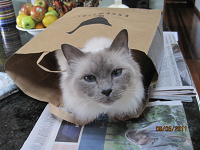

 She kept on yelling that plastic is murder, and that by wishing to use it, I was killing seal cubs and local fish.
 Can you explain, please?
 Imagine having a new POTUS every two years. I don't know what that says about Australia, except that maybe, we the people don't know what they want out of our politicians, but we're sure they're doing it wrong!